
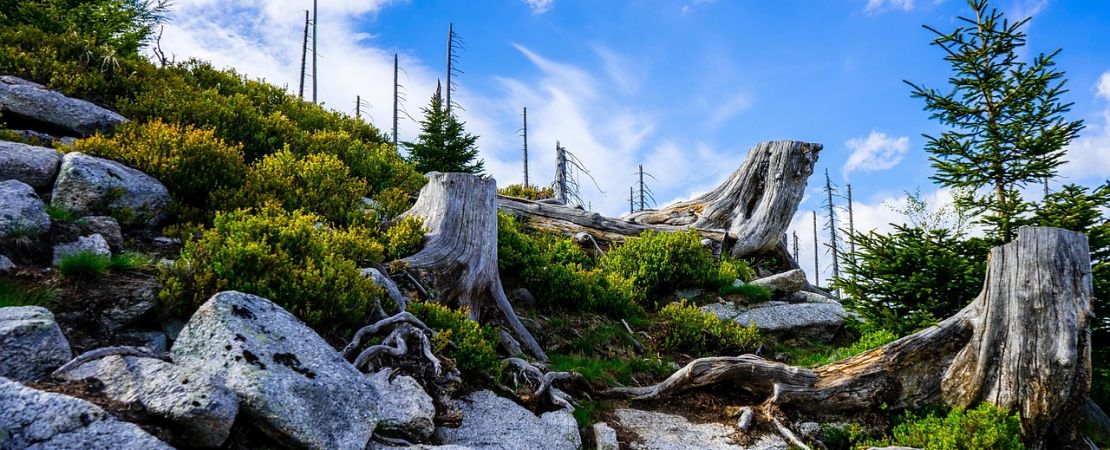
Following the bark beetle calamity and drought, simply replanting trees is no longer enough. Extensive restoration efforts are currently underway in European regions, altering the species composition, water regime, and structure of the forest.
When foresters return today to areas where spruce stands have collapsed, their work looks different than it did ten years ago. It is not about rapid reforestation with a single species. In many parts of Europe, including the Czech Republic, more diverse stands are emerging; water management in the landscape is being implemented, and the spatial structure of the forest is being restored.
In the restored areas, various tree species are combined; part of the territory is left to natural development, while in other areas, the soil and water regimes are being specifically managed. Here, the forest is not returning to its original “production” model, but is being rebuilt as a living system.
Czech experts and forest managers are also involved in these approaches. The Faculty of Forestry and Wood Sciences at the CZU in Prague participated in the EU-funded SUPERB project, conducting comprehensive field research and evaluating the impacts of individual interventions. The practical implementation was carried out by the forest owners and managers: Kinský Žďár a.s., Lesy ČR, s.p., and the Military Forests and Estates of the Czech Republic, s.p. It is precisely this combination of research and operational experience that has made it possible to test new approaches under real-world conditions.
Forest restoration is thus shifting from a one-time event to a long-term process that accounts for future risks, not past climate conditions.