

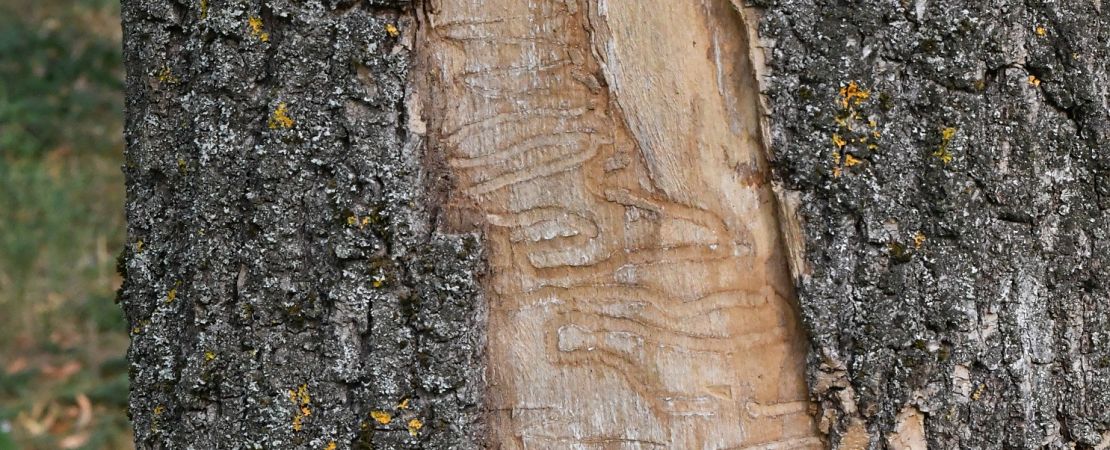
The emerald ash borer (Agrilus planipennis), an exceptionally destructive invasive beetle, has already been detected in Slovakia. According to Ing. Roman Modlinger, Ph.D., of the Forest Risk Research Centre at FLD CZU, its arrival in the Czech Republic is unlikely to be prevented. However, early detection may help slow its spread. To better understand the signs of infestation, the entomologist travelled to eastern Slovakia, where the pest has recently been found, and inspected infested ash trees in the field.
According to him, one of the most reliable indicators is woodpecker pecking damage on the bark. Beneath the bark, the beetle creates characteristic S-shaped larval galleries, while D-shaped exit holes may be visible on trees infested for a longer period. When searching for symptoms, foresters should focus particularly on sun-exposed ash trees along stand edges, in parks and avenues, and beside roads or paths.
In the interview, the scientist also explains why current monitoring methods may fail to detect the pest at an early stage and why he considers large-scale eradication efforts to be ineffective. He discusses the potential impacts on forests and urban green spaces and outlines the measures that should be taken to prepare for the beetle's arrival.
Read the full interview on the PROLES website.


Projekt HIVE 101187384.