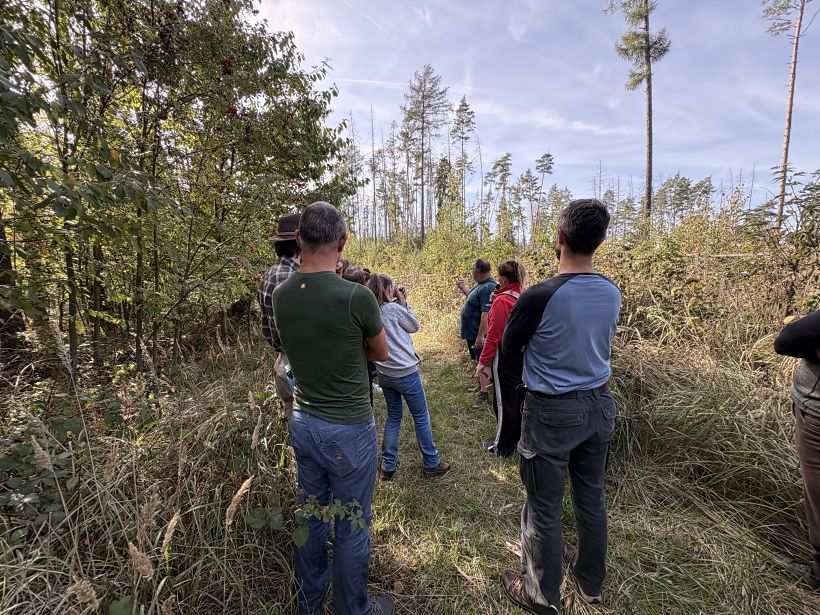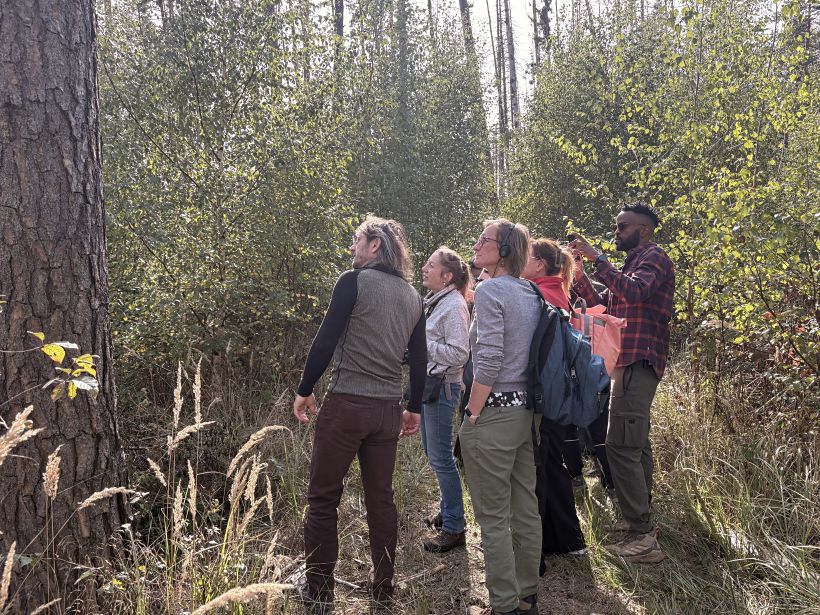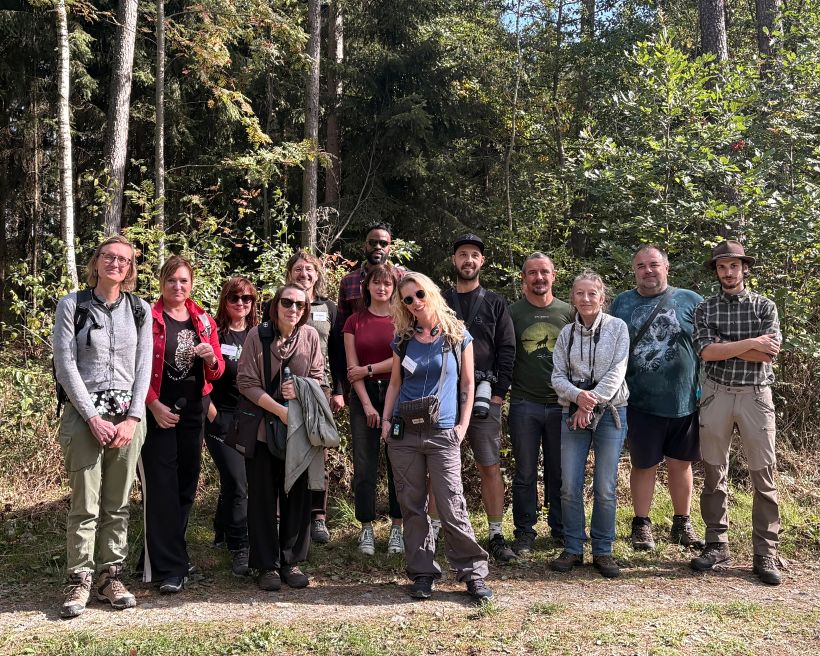
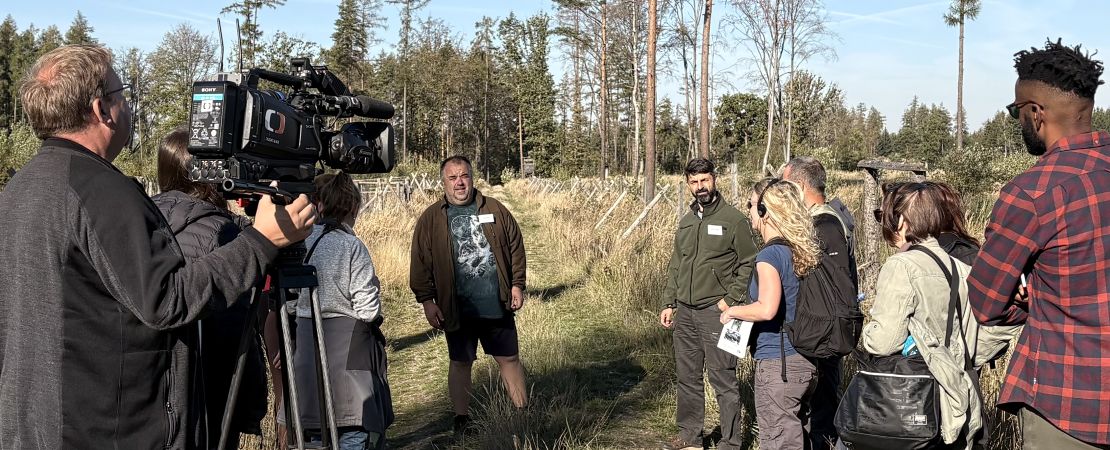
On 1 October 2026, an international field workshop for journalists took place in the forests near the town Velká Bíteš as part of the European TRANSFORMIT project, focusing on various methods of restoring commercial forests following a bark beetle outbreak.
What should be done with a forest when it has been destroyed by drought and bark beetles over the course of a few years? The usual approach is well known: fell the infested trees, clear the resulting clearings and then plant new saplings. However, Jiří Nohel, who manages the municipal forests in the Velká Bíteš area, decided during the bark beetle calamity not to follow part of this established procedure. On part of the land, he left the dead trees in place and entrusted much of the regeneration to natural processes.
Participants in a full-day field trip, which brought together foreign and Czech journalists, foresters and scientists from the Faculty of Forestry and Wood Sciences at the CZU Prague, and representatives of the European Forest Institute (EFI), had the opportunity to see the results of this decision first-hand in the field.
During the excursion, they visited several sites where they were able to compare different approaches to forest regeneration following a bark beetle outbreak. On the one hand, they saw areas where dead trees had been felled and new saplings planted; on the other, stands where regeneration had largely been left to natural processes. At these sites, a diverse mix of tree species is gradually establishing itself without extensive planting. The participants also discussed how deadwood left in the forest affects the soil, water regime, microclimate and biodiversity.
Another important topic was the economic aspect of various management methods – from the felling of storm-damaged timber through forest regeneration to subsequent aftercare. The discussion centred not only on what the forest looks like after a bark beetle outbreak, but also on how much its regeneration costs, how quickly it can regenerate naturally, and how resilient it can be to drought and other climatic extremes.
An expert perspective on the issue was provided by Prof. Ing. Miroslav Svoboda, Ph.D., and Assoc. Prof. RNDr. Jan Hofmeister, Ph.D., from the Department of Forest Ecology at the Faculty of the FLD CZU. Practical experience was shared by forest managers Jiří Nohel and Přemysl Tomek. The event was also attended by the town mayor of Velká Bíteš, Markéta Lavická, representatives from EFI, three foreign journalists and representatives from four Czech media outlets.
The forest estate – Velká Bíteš – is designated as a demonstration area (Satellite Demonstration Area – SDA) within the international TRANSFORMIT project. Here, the project draws on the specific experiences of foresters and landowners as an example of integrated forest management, which seeks to balance timber production, ecological stability, biodiversity, resilience to climate change and other forest functions.
The workshop thus brought the European debate on the future of forests out of the conference halls and directly into the field, raising a question that will become increasingly important in the coming years: Must a forest always start afresh on a clear-cut site following a major disturbance, or can its regeneration be based more on what already exists within the ecosystem itself?

TRANSFORMIT project, no. 101135263