
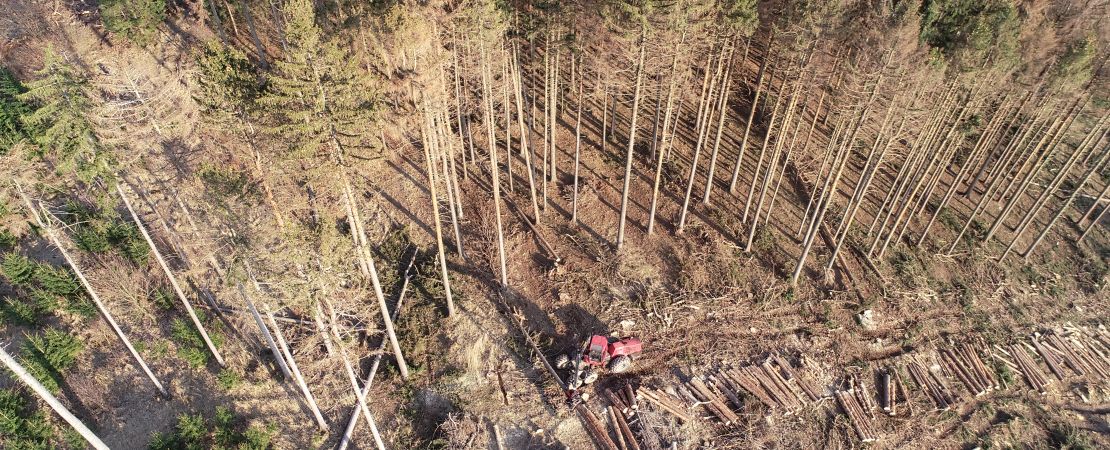
How can we prepare forests for drought, torrential rain or changing environmental conditions? The answer comes from the cross-border LESYpreKLÍMU project, which is now concluding two years of collaboration between Czech and Slovak experts. Its main outcome is the Strategy for Adapting the Forests of the Western Carpathians to Climate Change, which combines recommendations for forest management, game management and simple water retention measures.
The project ‘Nature-based Solutions for Forest Adaptation to Climate Change’ (LESYpreKLÍMU) brought together research institutions and state forest managers from the Czech Republic and Slovakia. In addition to joint data collection and the exchange of experiences, four demonstration sites were established, where the partners tested the proposed measures directly within forest stands.
The main technical output of the project is the joint ‘Strategy for the Adaptation of Western Carpathian Forests to Climate Changet’. The document was drawn up on the basis of joint data analysis, the exchange of experiences between Czech and Slovak partners, and findings obtained at the demonstration sites. It offers recommendations for forest adaptation management, ungulate management and the implementation of simple water retention measures.
“The strategy provides forest owners and managers with specific recommendations on how to increase the resilience of forest stands to ongoing climate change, namely through the promotion of biodiversity, water retention and anti-erosion measures, the tending of young stands, more nature-friendly forest management, and the regulation of ungulates. One of the key measures is the cultivation of mixed forests with an emphasis on species balance, which can increase production potential and carbon sequestration whilst simultaneously strengthening the stands’ resilience to drought, high temperatures and other climatic extremes,” said Assoc. Prof. Ing. Zdeněk Vacek, Ph.D., from the Faculty of Forestry and Wood Sciences at the Czech University of Life Sciences in Prague.
The project’s findings were presented during a field workshop held in June 2026 at the Duchonka Forest District in Slovakia. Out in the field, participants were introduced to the measures implemented, which are aimed at water retention in the landscape, the protection of water resources, and silvicultural practices that support natural regeneration and greater resilience of forest stands to climate change. The workshop concluded a series of Czech-Slovak expert meetings aimed at sharing experiences between research institutions and forestry practitioners.
The LESYpreKLÍMU project is being implemented under the Interreg Slovakia–Czech Republic 2021–2027 programme. The total budget amounts to €1,551,817, of which up to 80 per cent is funded by the European Regional Development Fund (ERDF). The project is coordinated by LESY of the Slovak Republic, with partners including the National Forestry Centre, Lesy České republiky, s. p., and the Faculty of Forestry and Wood Sciences at the Czech University of Life Sciences in Prague.